Musée Rodin

Historic mansion – check. Beautiful gardens – check. Artwork and sculptures – check. Pleasant and relaxing ambience – check. If any of these appeal, then ensure you pay a visit to the beautiful Musée Rodin whilst in Paris.

The museum is housed in the 18th century Hôtel Biron, which the French sculptor Auguste Rodin used as his workshop, and is situated in three acres of gardens that contain numerous sculptures dotted throughout – including one of his most renowned works, The Thinker.

*

Rodin donated the building, along with his entire collection of sculptures and other objects of art, to the French State on the condition the building be converted into a museum to display his collection. First opened to the public in 1919, it currently houses around 300 works.

Major works on display:

  • The Gates of Hell (La Porte de l’Enfer) (garden): Rodin was commissioned to design a bronze door for a Parisian museum of decorative arts. This work took shape as The Gates of Hell, depicting a scene from The Inferno, the first section of Dante’s epic poem The Divine Comedy.
  • Containing 180 figures, The Gates are six metres high, four metres wide, and one metre deep. Although the brief was for it to be completed in five years, Rodin worked on this project on and off for 37 years, until his death in 1917. The decorative arts museum was never built, so the work remained at Hôtel Biron.

*

  • The Thinker (Le Penseur) (garden): The Thinker is the central piece in The Gates of Hell. Originally called The Poet (Le Poète), according to the official Museum website, the statue was a depiction of Dante “contemplating his life’s work and the misfortunes of mankind”. Other critics believe that The Thinker is Rodin himself, pondering his creation. Yet another theory is it depicts Adam, contemplating the destruction brought upon mankind because of his sin.
  • The statue is now used as a universal figure to symbolise philosophy, and a large bronze casting sits on a raised pedestal amongst the garden. There are thought to be 28 full-size bronze castings of The Thinker around the world, not all of which were made during Rodin’s lifetime, nor under his supervision. In addition, there are various other versions made with different materials, and in a range of sizes.

*

  • The Kiss (Le Baiser) (interior of museum): The sculpture, The Kiss, depicts a 13th-century Italian noblewoman, Francesca (from Dante’s Inferno) who falls in love with her husband’s younger brother Paolo. The couple are discovered and killed by Francesca’s husband. If you look closely, you will note that the lovers’ lips do not actually touch in the sculpture – suggesting that they met their demise before their lips touched. The Kiss was originally featured in The Gates of Hell, but Rodin later removed it because it was not in alignment with the other suffering figures.
  • A large numbers of bronze casts have been made of The Kiss. But according to French law issued in 1978, only the first twelve can be called original editions. You will find a bronze version in the western corner of Jardin des Tuileries, near Musée l’Orangerie.

*

Entry to the Museum is 9, and it is accessible from metro stops Varenne (line 13) or Invalides (line 8 or 13; or RER line C). Audioguides and written leaflets in several languages are available. It’s open from Tuesday to Sunday from 10am – 5.45pm, and open late on Wednesdays until 8.45pm (later in summer).

There is a boutique/bookstore in the Chapel building that you enter through, where temporary exhibitions are also on display. A casual cafe is located in the gardens (open Tuesday to Sunday 10am to 5pm).

*

There is also another Museum located just outside of Paris at Rodin’s former home, the Villa des Brillants at Meudon (district of Hauts-de-Seine).

The overall collection of the Musée Rodin includes 6,500 sculptures; 6,500 drawings, watercolours and prints; 7,000 photographs; and over 6,400 objects d’art. Rodin’s works are also exhibited in over a dozen museums worldwide, and there is a Rodin Museum in Philadelphia, USA, and a Rodin Gallery in Seoul, South Korea.

*

Although I am by no means an art buff, it is a very pleasant setting to enjoy the art pieces, and roam around the lovely garden. Devote a couple of hours to visit all this site has to offer, more if you would like to rest in the gardens or have a break in the cafe.

The golden dome of Les Invalides and the top of the Eiffel Tower are both visible above the walls of the museum, so it also offers a few more Parisian icons to enjoy as part of the vista!

My foray into the brave, not-so-new-world, of social media!

A few weeks ago, I took the plunge and joined Twitter. A social media-savvy friend finally managed to persuade me that it would be a good idea. And I admit it, I’m hooked!

It’s such a fast-moving platform that you do need to be on there multiple times a day, which in itself, is time consuming. But the amount of valuable articles; information; other blogs; and websites I have discovered in a few short weeks – and in such a targeted way – would have taken me weeks (or months) to uncover by other means.

*

So I’ve become a dedicated student of social media over the past month or two, reading and researching the different platforms, and trying to determine which are advantageous to use for different purposes. One really helpful site I’ve come across so far is Social Media Examiner, which covers an array of social media sites and topics to help you navigate the minefield.

I do already have a facebook page for this blog, that admittedly, I have neglected over the time to only reflect articles as I post them. So I recently decided to revive it and post every 1-2 days – and noticed an immediate increase in engagement on my posts. A good incentive to keep it fresh and updated!

And I’ve just decided to make my profile public and become more active on Instagram, with Pinterest to follow suit soon….

*

And, as those of you who are already established and plugged into the social media platforms would be aware, there are numerous sites to help you more efficiently manage your social media profiles to reduce the time input you need, such as HootSuite, TweetDeck or Pluggio.

So as I reflect upon my new and unfolding journey of discovery, I thought I’d share a Twitter anecdote that really demonstrated to me the power of social media.

Photo of the Day Earth Pics TwitterAbout 2 weeks after creating my profile, I came across a photo contest offered by a website called Earth Pics (I found them on Twitter). They have a daily competition called “Photo of the Day”, whereby you upload a photo, and pin it to the world map to indicate its destination.

Each day they select a winning photo, and tweet the image and the profile name of the person who took it to their 1.8 million followers!

So I thought to myself “I have some pretty good photos, I’ll put my photo of the Taj Mahal at sunrise on there. I think it stands a good chance of winning!” (See the photo, and other inspiring pics from my travels here).

The following evening I was just starting to think I had better sign into Twitter and tweet an evening post……when my phone started madly beeping with new emails. Yep, my image had been selected as Photo of the Day, and I was getting retweets and favourties of the post on their Twitter site!

As of about a week later, it’s been retweeted over 400 times, and favourited more than 550 times. And that’s in addition to the countless others who would have seen the original post, seen it retweeted, and perhaps even decided to follow my profile on Twitter or looked up my blog as a result of seeing that one image. Not bad for a newbie without an established name or brand!

*

Then I discovered 3 days later that someone from Google Earth Pics had come across it, and uploaded it onto that website! See the image here.

So I was thrilled to see my photo being shared and enjoyed in cyberspace…..

And in the meantime, I will continue my foray into the brave new world for me that is Twitter (and beyond)…..so be sure to look me up! @SallyZeunert

(As an aside, it’s important to read the fine print of contests or competitions if you are wanting to retain the rights to your image and/or be informed as to how the site could potentially use it – not to mention the countless others who will also come across it and share it.)

Paris Photo Feature #1 – Nightfall at the Louvre

After trailing through thousands of my photos of Paris, I have finally compiled a photography portfolio of a small selection to publish on this blog. I consider it will likely be a fluid page, as I may add to it or modify it as I continue to accumulate photos…..it’s an endless labour of love that I enjoy immensely!

So I thought I would sporadically devote a blog post to a photo, or a small series of themed photos, that represent images that spoke to me, or invoke a memory of a particular place or moment when I captured them.

After all, akin to hearing a song; or revisiting a particular place; or catching up with an old friend; photos have so many memories associated with them.

They really are living, breathing things that come to life as you revisit them and remember where you were when you captured the image – was the weather cool or warm; were you alone or in a crowd; was it a spontaneous moment or a premeditated shot; was it your first time in that particular place, or was it a familiar or favourite locale; how were you feeling on that day – did anything of note, or excitement, or importance unfold?

It is never the same to look at someone else’s photos, since you do not inherently have these memories and associations with the image(s). So you could surmise an element of a great shot is that it can “stand alone” as a striking image, one that invokes emotion or feeling, without having to know the “story” behind it.

So, what to choose for my first image…..? A tough proposition!

I have selected two images for this post, captured on the same evening.

Sunset, Jardin des Tuileries

Sunset, Jardin des Tuileries

*

Location: Jardin des Tuileries

Timing: Sunset, April 2013

Sentiment: I had been in Paris for less than 3 weeks, and it was my first visit to Jardin des Tuileries and The Louvre with my camera. It was a lovely afternoon, and I had enjoyed whiling away several hours taking photos in the gardens, and in the nearby Place de la Concorde. I had planned on going home late afternoon, but was inspired to linger for sunset, since the weather was lovely, and I was enjoying myself so much!

I was rewarded with a beautiful sunset, and had a burst of inspiration to capture this shot as I saw the sun sinking towards the horizon, when I was near the statues in the gardens. It remains one of my favourite images I’ve captured of Paris so far.

*

Location: The Louvre

Timing: Nightfall, April 2013

Sentiment: Taken on the same day as above, I had lingered to capture the sunset in the nearby gardens. I met a friendly couple from Canada who were also biding their time until nightfall, we bonded over travel tales, and exchanging specs about our cameras.

As night set in, and the lights came on under the Pyramid and around The Louvre, I spent an hour or two taking photos from various angles and vantage points. This image is my pick of the collection from that evening.

I returned home feeling very happy and satisfied with my pursuits!

An icon turns 125

On the 31st March, the Eiffel Tower marked its 125th anniversary.

To pay homage, I thought I would recount some interesting facts about this Parisien icon; share some of my favourite photos that I have captured over the past year; and also list a number of vantage spots around the city where you can get great views of “The Iron Lady” – including a location along the Seine from another (surprising) icon!

And if you’re interested in historic photographs of the Eiffel Tower, National Geographic featured an article to mark this milestone (largely about Gustave Eiffel himself, whom they note as having “not a drop of romance in him”, who paradoxically, was instrumental in creating “the most romantic structure in Paris”!) that contains half a dozen beautiful historic images of the Tower.

*

Facts:

  • After more than two years of construction, the Eiffel Tower was completed on March 31st, 1889. It was the tallest man-made structure in the world, until it was overtaken by the Chrysler Building in New York in 1930.
  • It was named after Gustave Eiffel, the civil engineer and architect whose company designed and built the Tower. Contrary to popular belief, he himself did not design it.
  • A committee of 300 prominent artists, intellectuals and architects submitted a formal petition against its construction, labelling it “useless” and “monstrous”, and that the skyline of the city would be tarnished by it “dominating Paris like a gigantic black smokestack”. Obviously their pleas were unsuccessful!
  • The Tower was the main exhibit at the 1889 Exposition Universelle (World Fair), held to commemorate the centennial of the French Revolution. When it was first opened, the lifts were not in operation for several weeks, so nearly 30,000 visitors (out of the 1.9 million that visited it throughout the Fair) made the 1,710-step climb to the top on foot!
  • Eiffel Tower

    Eiffel Tower

    The lifts that take visitors up to the top of the Tower travel a combined distance of 103,000km a year – that’s two-and-a-half times the circumference of the Earth!

  • Over 250 million people have visited the Tower since its creation. Today, it receives over 7 million visitors each year, making it the most visited paid monument in the world.
  • The Tower gets repainted every 7 years, and requires 60 tonnes of paint per coat.
  • During WWII, as the Allies approached Paris in 1944 to liberate it from German occupation, Hitler ordered the military Governor of Paris to demolish the Tower (along with other parts of the city). The Governor refused.
  • In 2008, the Eiffel Tower was married. Yep, a woman with an objects fetish “married” the Eiffel Tower, and even changed her name to Erika La Tour Eiffel. Bizarre, but true.
  • Do you know the lights on the Tower sparkle for 5 minutes on the hour from nightfall until 1am? This beautiful sight requires 20,000 light bulbs.
  • Over its lifetime, the Eiffel Tower has housed a post office; a printing press; scientific laboratories; and even a theatre. Since 2004, the first level has been converted into an ice skating rink during winter.
  • In 1987, the pioneer of bungee jumping, AJ Hackett, made one of his first jumps from the top of the Tower. He was arrested upon reaching the ground.
  • The urban climber and rock climber Alain Robert, known as “French Spider Man”, scaled the Eiffel Tower in 1996/7 using only his bare hands – and no safety equipment!

*

“I bring to the Tower the testimony of a tireless pilgrim across the world. In the cities, in the savanna, in the pampas, in the desert, on the Ghats and on the estuaries, everywhere, among the humble and among the others, the Tower is in the heart of everyone, symbol of a beloved Paris, beloved symbol of Paris.”

Le Corbusier

*

Vantage points

There are many places you can see the unmistakable spire of the Eiffel Tower throughout the city, but here are a couple of nearby spots that are worth visiting.

Le Mur pour la Paix (Wall for Peace)

At the opposite (southern) end of the Champ de Mars (park) where the Tower is located, you will find the Wall for Peace (Mur pour la Paix).

*

Inaugurated in 2000, and designed to embody similar principles to the Wailing Wall in Jerusalem, this stainless steel and glass structure has the word “PEACE” engraved on it in 32 languages in 14 alphabets. The closest metro is École Militaire (line 8).

Île aux Cygnes

The “Isle of Swans” is a narrow man-made island that stretches for 850m along the Seine from Pont de Bir-Hakeim (the bridge to the west of the Eiffel Tower) down to Pont de Grenelle.

*

There is a tree-lined walkway (l’Allée des Cygnes) along the length of the island, where you will find people walking and jogging. There is a public work-out space underneath the Pont de Grenelle, and at the end – a replica of the Statue of Liberty!

*

The Statue of Liberty that stands in New York harbour was a gift from the people of France to the United States, to commemorate the 100th anniversary of American Independence.

An exact replica, although standing at one-quarter of the size of the original, was offered to the French by the American residents of Paris to commemorate the Centennial of the French Revolution. It was inaugurated in 1889, and positioned to face the Eiffel Tower. However, its creator, the architect and sculptor Frédéric Auguste Bartholdi, wanted it to face in the direction of New York. He succeeded in having the statue turned to face its counterpart.

*

There is another statue in Paris – the original plaster can be seen in the Musée des Arts et Métiers. A replica of the torch (to scale), the Flame of Liberty, can be seen above the entrance to the Pont de l’Alma tunnel.

The tablet the statue is holding is inscribed with the dates “IV Juillet 1776 et XIV Julliet 1789” – recognising American Independence Day, and Bastille Day in France.

Views from Place de la Concorde, Eiffel Tower

Views from Place de la Concorde, Eiffel Tower

Other vantage points include:

  • Place de la Concorde and Jardin des Tuileries (particularly at the western end, best views from the elevated sections near Musée de l’Orangerie)
  • Pont Alexandre III
  • Sacre Coeur (as you exit the Basilica you’ll see it through the trees!)
  • Tour Montparnasse (entry fee to the Tower required, see article here)
  • Rooftop of Galeries Lafayette department store (open during summer), or the nearby Déli-Cieux at Printemps department store
  • Le Georges restaurant/bar atop the Centre Georges Pompidou (Not for the budget-conscious! Otherwise, pay 3 to go to the observation level of Centre Pompidou for a budget-friendly option)

*

Trocadero, Views to the Eiffel Tower

Trocadero, Views to the Eiffel Tower

So be sure to enjoy the Eiffel Tower from these, and numerous other, vantage points around the city.

And if you’ve not seen the Tower before, the highest-impact approach is to catch the metro to Trocadéro (line 6 or 9). As you exit, within seconds you will have the Tower revealed to you in all its glory, and be well-positioned for some great photos too!

And if you want to brave the crowds (as I am yet to do on this trip, but did visit in 2001!), pay your €15, pack your patience, and take the lift to the top to enjoy the panoramic views. You can even celebrate your ascent with a glass of bubbles at the champagne bar at the top!

*  *  *

“I ought to be jealous of the tower. She is more famous than I am.”

Gustave Eiffel

It’s been a year…..!

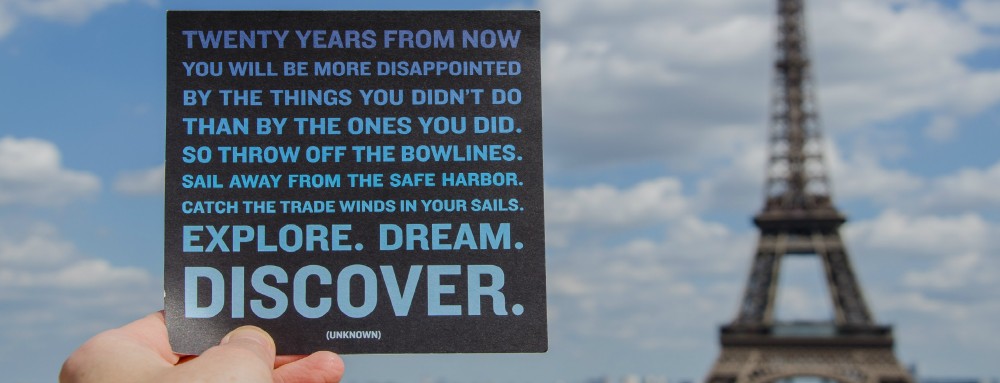
This time last year, I posted the following quote on my facebook wall:

*

It was just before I departed Australia, having resigned from my job, and having sold my apartment. I was about to embark upon a dream to return to Paris – and live off my life savings to do so!

It was a leap of faith. I knew only one person, and had no idea what would unfold. All I did know was that it was time for a change. In my career, and in my general direction in life. It just felt right.

And I am a big believer in trusting your intuition.

Over the past decade, I have tried to become more aware of my thoughts; behaviours; attitudes; and my motivation for decisions I make in my life.

And in the past, when I have made major life decisions and changes – such as relocating overseas, and moving cities within Australia – I have felt it. Whilst it may be intangible to others, I truly believe that within ourselves, we “know” what is right for us.

The problem is, we often let our head get in the way.

We tend to discuss, analyse, and generally over-think our situations. Which often leads to fear and doubt seeping in…..invariably causing us to opt to remain in our comfort zone – the safety of what we know – even though we may be unhappy.

“Every right decision I’ve made—every right decision I’ve ever made—has come from my gut. And every wrong decision I’ve ever made was a result of me not listening to the greater voice of myself. If it doesn’t feel right, don’t do it. That’s the lesson. And that lesson alone will save you, my friends, a lot of grief.”

Oprah Winfrey

*

So I was determined not to look back on my life with regret. To know I had the courage to change my circumstances when I was not satisfied and fulfilled. After all, what’s the worst that could happen?

And how often am I grateful I did? Every day!

*

I have travelled to over 50 countries, but have always felt a strong affinity for Paris. At school, I had dreamt of one day travelling to France, of speaking the language, and experiencing life here. I spent six weeks in France back in 2001, and of all the destinations I have since visited, I just knew that Paris was the right place for me to return to at this time in my life.

So today marks the one year anniversary of my arrival. Of starting anew – developing new friendships and networks, learning a new language, and growing accustomed to the cultural differences and nuances as I gradually assimilate into life here.

My focus has been on myself this past year. On rebuilding my energy and inspiration, and in developing greater clarity on where I am actually headed. It’s such a great gift to be able to spend quality time on yourself in this way!

So I have spent countless hours reading inspiring books; undertaking courses and programs; listening to audios and watching webinars about mindset, belief, positive thinking, Law of Attraction, and wellness; taking French classes; and snapping lots of photos.

And I have also spent time on consciously and clearly laying out my goals. Although this is still a work in progress, I firmly believe the adage:

How do you know what you’re aiming for, if you haven’t clearly defined your target?

Many people drift along year after year, feeling somewhat discontent, but not really knowing what it is that they want. Our lives are busy, and full of distractions. But what is more important than investing in yourself, and determining what exactly YOU want out of YOUR life? As the late, great Steve Jobs said:

*

(And by the way, if you’ve never seen his Stanford University address [2005] – where this quote originates from – then click here. It remains one of the most inspiring speeches I have ever heard.)

I still feel I have so much to read, learn, and discover. I just love learning and growing every day, as I gain new insights and realisations, and increase my self-awareness. And it makes me realise how much I really don’t know, and still have to learn!

How long will I remain in Paris? I don’t know. But I do know I’m in the right place for me, right now. And that I feel much happier; more content; positive; inspired, and excited about life as a result of making this change.

So I am in the process of renewing my visa for another year. After that, I’ll reassess, and see what feels right.

I have so many things I still wish to achieve, so it certainly is a work in progress. But as a close friend remarked to me yesterday: “You are certainly looking at the next year through a different lens to last year!” And I am excited about the ongoing journey.

Follow Your Dream!!! 🙂

365 days, 52 weeks, 8,760 hours, 525,600 minutes, 31,536,000 seconds……

C'est moi! Brick Lane, London

C’est moi! Brick Lane, London

*  *  *

“Paris is a place in which we can forget ourselves, reinvent, expunge the dead weight of our past.”

Michael Simkins

*
“A walk about Paris will provide lessons in history, beauty, and in the point of Life.”

Thomas Jefferson

*  *  *

Postscript…..

Quotes

There are many quotes that I have been inspired by. The two stand-outs would have to be:

“Go confidently in the direction of your dreams. Live the life you’ve imagined.”

Henry David Thoreau

*

“Twenty years from now, you will be more disappointed by the things you didn’t do than by the ones you did. So throw off the bowlines, sail away from the safe harbor. Catch the trade winds in your sails. Explore. Dream. Discover.”

Mark Twain

*

Photos

This is a tough one – almost like asking a parent to choose their favourite child! 😉 I have thousands of photos, many remain as yet unsorted. So, after much deliberation, I have selected a handful of my favourites:

*

*

*

*

*

*

*

My ‘Paris photography portfolio’ page is coming soon!

*

Books

I have read some really incredible mind-expanding books over the past year. The stand-outs would have to be:

“The Four Agreements: A Practical Guide to Personal Freedom” Don Miguel Ruiz

Highly, highly recommended for anyone who wishes to gain an insight into the way we are conditioned to think, and how to break free of the drama this causes in our lives.

Empowering and inspiring!

Core concepts are:

1. Be impeccable with your word – Your word is the power that you have to create. So speak with integrity, and say only what you mean. Don’t use the word against yourself (judgement or blame), or engage in gossip. Use the power of your word in the direction of truth and love.

2. Don’t take anything personally – Nothing others do is because of you. What others say and do is a projection of their own reality and agreements, their own ‘dream’. When you are immune to the opinions and actions of others, you will free yourself, and won’t be the victim of unnecessary suffering.

3. Don’t make assumptions – Ask questions to gain information and clarity on situations, and express what you truly want. Communicate with others openly and clearly to avoid misunderstandings. We only see what we want to see, and hear what we want to hear. We also make the assumption that everyone sees life the way we do. If you stop making assumptions, your relationships with others will be transformed.

4. Always do your best – The first three agreements will only work if you do your best. This enables you to accept yourself. But you have to be self-aware, and learn from your mistakes. Know that ‘your best’ is going to change from moment to moment, and day to day. Surrender and let go of the past. Do the best you can at any given moment, keep practising, and create new habits and rituals that serve you.

*

“The Strangest Secret”

Earl Nightingale (book and audio recording).

Although recorded in the 1950’s, it still rings true today.

The strangest secret is cited as:

“We become what we think about”.

He states the “trouble today” is conformity. People acting like everyone else without knowing why, and without knowing where they’re going. A survey of “working men” found 19 out of 20 stated that the reason they go to work in the morning is “because everyone else is doing it”!

He defines success as “the progressive realisation of a worthy ideal [goal].” And that people with goals succeed because they know where they’re going.

“Plant your goal in your mind. It’s the most important decision you’ll ever make in your entire life.”

*

“Believe and succeed.”

I’d also like to add that thoughts are things! And the key element is belief – knowing and feeling that you can achieve your goal.

If you want to know what you have been thinking about, feeling, and believing in the past, then look at your life as it is now.

*

Music

Two songs that have been my “themes” for the last year or so:

“It’s my life” Bon Jovi

It’s my life, it’s now or never

I ain’t gonna live forever

I just want to live while I’m alive

(It’s my life)

My heart is like an open highway

Like Frankie said I did it my way

I just wanna live while I’m alive

“Man in the Mirror” Michael Jackson

I’m starting with the man in the mirror

I’m asking him to change his ways

And no message could have been any clearer

If you wanna make the world a better place

Take a look at yourself and then make a change

*  *  *

Feel free to share any book recommendations or inspiring quotes in your comments. I’d love to receive them 🙂

Versailles

If you only do one day trip out of Paris, make it to the UNESCO World Heritage-listed Palace of Versailles (Château de Versailles). The opulence and grandeur of the Palace and its gardens makes battling the inevitable crowds worthwhile!

*

When it was built, Versailles was a village out of Paris, but now the urban sprawl has effectively enveloped it as a well-to-do outer suburb of the capital.

Easily accessible on the RER C train line from central Paris, it’s around a 45 minute journey to Versailles-Château – Rive Gauche station. From here, it’s a 5 minute walk to the Palace. But do note you can’t use a regular metro ticket that’s zoned only for Paris, buy a specific destination trip from a machine at any metro station (fare 3.45 one way).

The gardens and park are open every day, but the buildings are closed on Mondays. It’s also possible to visit the gardens without entering the Palace, and during the winter months, it’s free to do so.

It’s worth checking out the official website prior to your visit, for all the details on opening hours and ticket options. An all-inclusive ticket (with audioguide) for all the buildings and the gardens – which offers the best value if you’d like to explore more than just the Palace itself – will cost 18.

*

Allow a full day to visit the site if you don’t want to feel rushed, to enable ample time to enjoy the vast gardens and general ambience.

I was treated to a beautiful spring day, and there were lots of people riding bikes, jogging, and picnicking by the canal. Although do note if you visit during the colder months that the fountains are not in operation – as was the case during my visit.

*

History

  • Palace of Versailles

    Versailles was originally a hunting lodge built under Louis XIII in 1624, but it was his successor, Louis XIV, who enlarged it and developed the Palace it resembles today.

  • Louis XIV gradually shifted the royal court out of Paris and into the Palace, and it was officially established as the seat of the court by 1682.

  • Versailles remained the seat of the monarchy until the royal family was forced to return to Paris in October 1789, after the start of the French Revolution.
  • In the 19th century, the Palace was converted into the Museum of the History of France.

Several dozen rooms are open to the public to visit, and you may take photographs (without flash). But do note if you are carrying food, you will have to leave your bags in the lockers prior to entering.

*

Be prepared for the hoardes of visitors, so practice patience, and try not to let it detract from enjoying the opulent decorations, furniture, and artwork.

The highlight of the Palace is undoubtedly the famous Hall of Mirrors, where Louis XIV was renowned for his lavish displays of wealth to impress his visitors.

*

*

Other buildings within the grounds

In 1687 the Grand Trianon was built, which acted as a refuge from the main Palace for Louis XIV. Napoleon Bonaparte subsequently had the palace restored, and stayed here many times with his second wife, Empress Marie-Louise.

From 1963, French President Charles de Gaulle utilised it as a guesthouse for the presidents of France, and the northern wing was converted into an official presidential residence.

*

There is also a Hamlet estate within the grounds. The Petit Trianon was built by Louis XVI for Queen Marie-Antoinette in 1774, and she took up residence here, away from the rigors of court life.

Gardens

The gardens were commissioned by Louis XIV in 1661, and the work took forty years to complete.

Allow at least an hour or two to explore the gardens, more if you would like to sit and take a break in order to fully appreciate your surrounds.

*

Within the grounds you will find several eateries (from casual crepes and pizzas, to an Italian restaurant), as well as boats for hire on the Grand Canal (30 minutes is 11; one hour costs 15). You can also hire golf buggies to zoom around the expanse of the park if you would like to rest your legs!

So, take a break from the city, and do yourself a favour and pay a visit to this beautiful Palace and its gardens.

A triumph, in every sense!

At the centre of arguably the world’s most famous roundabout – for all the wrong reasons! – the Arc de Triomphe de l’Étoile is one of the icons of Paris.

*

The location where tour buses are renowned for seeing how many loops their drivers can manage on one of the eight lanes before they get dizzy, only the bravest (or craziest) of drivers will tackle it. But the centrepiece is something that should be on every visitor’s list.

Views from atop the Arc de Triomphe

Views from atop the Arc de Triomphe

With 12 avenues radiating out from Place Charles de Gaulle, where the Arc is located, it is certainly a sight to behold. And probably the most famous of them all, the Champs-Élysées, stretches out down to Place de la Concorde, Jardin des Tuileries, and The Louvre beyond.

The Arc de Triomphe is accessible by the metro and RER (Charles de Gaulle—Étoile station). It’s open from 10am until 10.30pm in winter, and 11pm in summer. It is closed on a handful of public holidays throughout the year, so check beforehand if you’re unsure here.

And don’t even think about crossing the road – take the underpass, just near the exit of the metro.

*

The Arc is dedicated to those who fought and died in the French Revolutionary and Napoleonic wars. It was commissioned by Napoleon after his victory at Austerlitz in 1806, but it wasn’t completed until 1836 – 15 years after his death.

Some historical facts:

  • The monument stands at 50 metres high, 45m wide and 22m deep.
  • The design was modelled on the Roman Arch of Titus.
  • When Baron Haussmann re-designed the centre of Paris in the 1800’s, he wanted the Arc de Triomphe to be a focal point from which the most important roads led.
  • The sculptures and reliefs on the Arc depict key moments from the French Revolution and Napoleonic battles. The inner facades contain engravings of the names of military leaders. The four figures on either side of the arcades depict characters from Roman mythology.
  • If you would like to read more about the significance of the sculptures and reliefs on the monument, this Wikipedia article outlines the motifs and their depictions.
  • Tomb of the Unknown Soldier

    Tomb of the Unknown Soldier

    Beneath the middle of the Arc is the Tomb of the Unknown Soldier, containing the remains of a WWI soldier, and dedicated to the memory or those who died in both World Wars who were never identified. Interred in 1920, it was the first eternal flame in Europe.

  • Each day, there is a memorial service at 6.30 pm to remember those who died in battle from WWI to the present day.
  • The Arc has been the location of numerous historic celebrations over the years, and the annual Bastille Day parades (on July 14th) occur here.

*

*

And, some interesting addits:

  • Napoleon intended for the Arc to be completed in time for his new bride Archduchess Marie-Louise of Austria, in 1810. However, it was far from being finished, so he had a wooden replica of the Arch constructed for them to walk through as they entered Paris instead.
  • Napoleon never did see the completion of the monument, however his remains were taken under the Arc in 1840 – almost 20 years after he died – on their way to his final resting place at Invalides.
  • The Arc was the largest triumphal arch in the world until it was surpassed by the Arch of Triumph in Pyongyang (North Korea), in 1982.
  • After the end of World War I, Charles Godefroy flew his Nieuport biplane through the middle of the Arc in tribute to those who died in the war. The event was captured on newsreel, and you can see it on YouTube here (don’t blink, it’s a short clip!).
  • In 1961, US President John F Kennedy and his wife Jacqueline Kennedy visited the Tomb of the Unknown Soldier. This visit inspired Jackie to have an eternal flame created for her husband after he was assassinated in 1963.
  • President Charles De Gaulle narrowly escaped an assassination attempt at the Arc (in total, he survived over 30 attempts at his life!); and in 2002, during Bastille Day celebrations, President Jacques Chirac dodged a bullet here as well.
  • Although dedicated to French victories, during the Franco-Prussian War the Germans marched under the Arc in 1871. The Nazis likewise did the same during the German occupation of Paris during World War II.
  • The annual Tour de France bike race finishes here.

The sculpture work is truly beautiful, do make sure you spend some time walking around the base of the Arc to look at the details on the pillars; archways; and on the interior of the Arc.

Napoleon features on one of the four main sculptures on the pillars, where he is being crowned by the goddess of Victory.

*

While you’re here, it’s worth climbing the 284 steps to the rooftop (9.50€). The stairs are narrow and winding, so bear that in mind if you don’t like confined spaces!

The low-rise vista of the city is evident from the platform at the top, meaning you do get very good views, even though you are not particularly high up. When you have climbed the main stairs, you will find a small collection of information and relics about the construction of the Arc; a souvenir shop; and even bathrooms, before you venture out onto the roof.

At the time of my visit, there was some repair work going on to the exterior, and a section of the rooftop was inaccessible – the spot providing the best views of the Eiffel Tower! But it was still visible – albeit at an angle, and having to patiently wait your turn for a vantage point to snap your photos.

The Arc is at the centre of the historic axis stretching from the courtyard of The Louvre, along the Champs-Élysées, and through to the Grande Arche de la Défense (in the La Défense business district). You will gain an appreciation of this geographical layout from atop the Arc. La Défense is visible, along with numerous famous sights, including Sacre Coeur; Montparnasse Tower; the Eiffel Tower; and the dome of Invalides.

*

I recommend timing your visit for around half an hour before sunset, or even around the time of sunset, so you can get views with the light, but also enjoy nightfall and see the lights come over the city – including the Eiffel Tower.

*

It certainly is a feat of triumphal architecture! Enjoy your visit.

On top of the world!

It’s hard to miss the Montparnasse Tower (officially called the Maine-Montparnasse Tower; or in French: Tour Montparnasse) when looking out over the vista of Paris. At 210m and 59 floors, it’s an obvious structure to spot against the low-rise backdrop of the city.

I’ll be honest, I’ve always viewed is as an anomaly, and frankly, an ugly blip on the skyline. And it seems my opinion is shared by many others. This excerpt comes from the Wikipedia article on the building in the section titled “Criticism”:

“The tower’s simple architecture, large proportions and monolithic appearance have been often criticized for being out of place in Paris’s urban landscape. As a result, two years after its completion the construction of buildings over seven stories high in the city center was banned…

It is sometimes said that the view from the top is the most beautiful in Paris, because it is the only place from which the tower itself cannot be seen.

A 2008 poll of editors on Virtualtourist voted the building the second-ugliest building in the world.”

And just out of interest, the illustrious title of #1 ugliest building in this survey was the Boston City Hall!

The Tower was built from 1970-3 above the Montparnasse — Bienvenüe metro station, after an urban renewal project was completed in the area back in the 1950’s. It was the tallest building in Paris, until it was surpassed by another skyscraper in the La Défense business district (on the outskirts of Paris) in 2011.

Over 5,000 people work in the Tower, and there are over a million visitors who scale its heights to enjoy the vistas of Paris it offers – in my opinion, its only redeeming feature!

*

Here are a few interesting facts:

  • The building has 25 lifts, and 5 freight lifts. The fastest lift zooms you up to the 56th floor in just 38 seconds, reaching speeds of 60km/hour.
  • The tower has 7,200 windows – that’s a lot of cleaning!
  • In clear weather, you can see for up to 40km.
  • There is a quality restaurant that shares real estate space with the viewing platform on the 56th floor: Ciel de Paris, and a champagne and cocktail bar. Trip Advisor users rate the restaurant favourably, if you’re looking for a special dining experience with great views of Paris – and don’t mind allocating the budget to indulge! That said, they do offer a 2-course lunch for 30€, or 3 courses for 39€ – quite reasonable considering the prime real estate you are occupying.
  • In 1995, Alain “Spiderman” Robert, the French urban climber, scaled the building using only his bare hands and feet – without any sort of safety device! He has also climbed many other world-famous buildings, such as the Eiffel Tower; the Sydney Opera House; Tapei 101 (the world’s tallest building at the time); and after two faulted attempts (resulting in arrest when he reached the 60th floor), he successfully scaled the Petronas Twin Towers in Malaysia in 2009.
  • From the top, you can’t see the ugliness of the building itself on the Paris skyline! 😉

For 14€ (free for children under seven), you will be granted entry to the enclosed indoor viewing platform on the 56th floor, and the outdoor (perspex enclosed but with an open roof) platform on the 59th floor. It is easily accessible from the Montparnasse — Bienvenüe metro station.

The official website has lots of useful information, and you can also pre-buy your tickets online if you wish. However, they have two cashiers at the site, and from the accounts I have read, queues are usually minimal.

On the 56th floor, you will find the casual 360° Café for snacks and drinks, a souvenir shop, and interactive screens with information about the sights you are looking at. At this level, you will get good views of the main sights such as the Eiffel Tower; the Arc de Triomphe; The Louvre; and Sacre Coeur in the distance.

But the real gem is the 360° viewing platform on the 59th floor, reachable by stairs to the outdoor rooftop.

*

I timed my visit to be arrive approximately an hour before sunset, which I recommend to enable you to see the skyline while there is still daylight, but enjoy the approach of nightfall as well. The outdoor platform on the 59th floor has gaps in the perspex barriers where you can take unobstructed photos of the city’s skyline.

It really was spectacular to watch night unfold over the city.

*

And after a stunning sunset, the city lights started to emerge as darkness enveloped the skyline.

*

Be sure to stay and watch the lights on the Eiffel Tower sparkle for 5 minutes (on the hour), which really was beautiful to watch from this height.

*

The Montparnasse Tower offers a great alternative to the lengthy queues at the Eiffel Tower, with the added bonus of being able to see the Eiffel Tower as well! It is not quite so centrally located, so you can’t peer down at the Seine, or obtain a close up view of some of the monuments – although there are large binoculars on both levels of the viewing platforms to enable closer views.

I really enjoyed my visit, and would recommend at least an hour or two to fully appreciate the vistas, and linger for a drink in the café if you can nab one of the bar tables by the window.

*

And perhaps next time, I’ll have to treat myself to a meal at the restaurant to fully make the most of the views and experience it offers!

A macabre attraction

If you are looking for something completely different from the monuments and beautiful buildings that Paris offers, then consider a visit to the Catacombs.

Today the site contains an underground ossuary of human skeletal remains some 20 metres under the ground, but it has played numerous important roles in the history of the city, from the very origins of settlement here.

*

So it’s worth recounting a brief history:

  • Around the first century AD, the Gallo-Romans built the city of Lutetia (Gallo-Roman Paris) using local limestone deposits. The city was named after the geological ‘Luetian’ period in which the limestone in this geographical region was formed.
  • In the 13th century, the quarries were extended underground to meet the demand for stone required to build The Louvre, Notre-Dame cathedral, and the city ramparts.
  • When the city’s cemeteries became full in the 18th century and public health concerns started to arise, a decision was made to place some of the remains into the disused quarries.
  • The ossuary contains the remains of approximately six million Parisians, transferred there gradually between the late 18th and mid-19th centuries. The first was Cimetière des Innocents in 1786, in what is now the district of Les Halles.
  • Paris actually contains numerous underground mines – there are three main networks beneath the city. The majority of the product that was extracted was gypsum, used to make “plaster of Paris”!
  • Numerous mine cave-ins have occurred in the past, leading to improved charting and maintenance of the mines from 1777.

The Catacombs in their first years were simply a bone repository. But the head of the Paris mine inspection service from 1810 undertook renovations that transformed the site into a mausoleum that could be visited. This included deliberate arrangements of the bones; stone inscriptions; and a room displaying various minerals mined from Paris’ underground.

*

From their creation, the Catacombs became a ‘curiosity’ for Paris’ more privileged residents to take private tours of the site. Over the ensuing decades, the mine authorities allowed opening of the site on a more regular basis to allow visitors through.

The Catacombs are located beneath the metro and sewer system of Paris, at a depth of 20 metres. You will walk for approximately 2km through the passageways, 800m of which comprise the ossuary. This is only a fraction of the 11,000 square metre area they are contained within. The passageways are not too confined or narrow, but if you really don’t like dark, small-ish spaces, then perhaps reconsider your visit!

*

Catacombs, ParisThe initial part of the visit takes you through underground passageways, containing various points of information, including discussions of the geological history of the site.

At the entry to the ossuary, a stone portal bears the inscription: “Arrête! C’est ici l’empire de la Mort” (Stop! Here lies the Empire of Death). As you walk through this section, there are numerous arrangements of the bones and skulls, such as a series of skulls arranged in a heart shape; and a central pillar shaped like a keg. Interesting, but also slightly spooky!

*

Entry costs 8€, but it’s worth investing an extra 3€ for the audio guide. Although there is some written information (in French and English), having an audio guide does add to the experience, and provides a greater understanding of what you are looking at. The ambient temperature is around 14°C, so dress accordingly.

It’s open from 10am – 5pm daily, aside from Mondays and public holidays, and metro Denfert-Rochereau (lines 4 or 6) is just across the road. There is information about the site on the official website too.

*

Allow at least an hour for your visit – more if you want to read all the information and take photos etc. But do note you cannot use flash or a tripod, so unless you have a camera that manages low-light photography, you may not get good results.

So if you’re looking to explore a completely different side to Paris, then this fascinating site could fit the bill. It really is a slightly surreal experience to visit!

Images of winter in Europe

Happy new year! Over Christmas and new year I took a hiatus from this blog while I ventured out of Paris, and did some travel in several other European destinations.

Although I did not encounter snow, it was lovely to experience a wintry Christmas, with its decorations and festive cheer that are uniquely European.

So before I resume chronicling my adventures in Paris, I thought I’d post a small collection of some of the images I captured.

London, England

*

*

Copenhagen, Denmark

*

*

*

Berlin, Germany

*

*

*

Bruges, Belgium

*

*

*

Ghent, Belgium

*

Brussels, Belgium

*

Although I had previously visited all of these locations when I lived in Europe from 2001-2003, I really enjoyed rediscovering them with new eyes – and a new camera!